Carbon Capture and Storage (CCS) is a high volume, large industrial process that can make significant reductions in the amount of CO2 present or being released into the Earth’s atmosphere. It involves:
- capturing CO2 by separating it from other gases, combustion products or air
- compressing the CO2 to a liquid or super-critical fluid state
- transporting the CO2 (usually via pipelines)
- injecting the CO2 underground for permanent storage (usually at depths greater than 1 kilometre below the surface) into suitable geological formations such as depleted gas reservoirs or hyper saline aquifers.
Trapping carbon is also referred to as carbon sequestration.
Global commercial CCS facilities
Carbon Capture and Storage (CCS) is not a new technology and has already been occurring in Europe and the United States for many decades as a proven decarbonisation tool.
According to the latest information from the Global Carbon Capture Storage Institute (GCCSI), there are now 77 commercial CCS global facilities in operation, capturing approximately 64 million tonnes of carbon dioxide (CO2) per annum (Mtpa). 64 Mtpa is about the same amount of emissions produced by 14 million petrol vehicles in one year. An additional 449 Mtpa in capacity is either in development or under construction.
A leading carbon management solution
Gases such as CO2 and methane have naturally been trapped in underground geological formations for millions of years. These underground geological formations also have certain favourable conditions for injection and storage including, their porosity and permeability and being covered by an impermeable cap rock that prevents the CO2 from escaping.
Over time the CO2 can react with the underground conditions and convert from a gaseous state to a stable solid carbonate mineral. This process is called carbon mineralisation or mineral carbonation.
CCS is recognised globally as a leading carbon management solution, particularly in hard-to-abate industries such as natural gas production, steel, cement, aviation and agriculture. CCS can remove very large volumes of CO2 from circulation and the 2 operating CCS facilities in Australia are currently storing approximately 2 million tonnes of CO2 every year.
The International Energy Agency has stated that it will be virtually impossible to reach net zero emissions by 2050 without the large-scale deployment of global CCS facilities.
The Northern Territory has enormous on and offshore geological potential to play a major role in the global efforts to decarbonise through capturing and storing carbon deep underground.
-
Decades of research highlight the Petrel Sub-basin as a highly prospective, low-cost geological storage site, with capacity in excess of 20 million tonnes of carbon per year, with an effective storage capacity of 6.48 gigatonnes. Figuratively this is the capacity to store around 374 years worth of carbon produced across the Northern Territory each and every year or 13 years Australia-wide, based on 2020 emissions.
The Bayu-Undan CCUS project has the potential to store up to 10 million tonnes of carbon per annum, equivalent to about 1.5 per cent of Australia’s carbon emissions each year.
Collaboration is essential to realise decarbonisation solutions, pave the way for substantial industry growth and transition towards a net zero emissions future.
-
This project is a joint venture between INPEX, Woodside Energy and Total Energies who were awarded a greenhouse gas storage assessment permit in 2022 from the 2021 Offshore Greenhouse Gas Storage Acreage Release.
A geological storage exploration and appraisal work program in the Petrel Sub-basin is underway to assess the viability of this highly prospective storage resource.
The project is a significant step towards realising a large-scale CCS industry for the Northern Territory and has the potential to become one of the largest CCS projects in the world.
The INPEX-operated Ichthys LNG facility located at Middle Arm would be a significant user of this CCS facility, as it seeks to reduce its emissions and advance realisation of a net-zero carbon society by 2050. INPEX are targeting operation in 2031 with investment estimated at up to 100 billion yen (A$1.2 billion).
The Australian Government awarded the Bonaparte CCS Project Major Project Status in July 2025. For more information about this major development initiative, go to the INPEX website.
-
Santos has recently begun operation of an onshore CCS facility at Moomba in South Australia.
Testing the viability of the existing Bayu-Undan infrastructure in the Timor Sea and using the reservoir for carbon capture storage is underway by Santos, operator of the Bayu-Undan offshore gas production facility.
A memorandum of understanding has been established between the operator and the Timor-Leste regulator to explore opportunities to permanently store approximately 10 million tonnes of carbon per year.
This project will see the existing Bayu-Undan to Darwin pipeline repurposed to facilitate CCS. The new duplication pipeline will transport gas from the offshore Barossa Field, located 300 kilometres north of Darwin, to the onshore Darwin LNG facility at Middle Arm. The Bayu-Undan CCUS project has the potential to store up to 10 million tonnes of carbon per annum, equivalent to about 1.5 per cent of Australia’s carbon emissions each year.
For more information about Santos’ midstream and energy solutions, go to the Santos website.
-
Carbon Capture, Utilisation and Storage (CCUS) includes the downstream ‘use’ or ‘utilisation’ of the captured carbon dioxide from industrial activities, which can then be used for carbonation, fire suppression, concrete curing and welding. CO2 can also be used to manufacture products like fertiliser, methanol, plastic polymers and foam, and when combined with renewable hydrogen, can also produce synthetic sustainable aviation fuel (SAF).
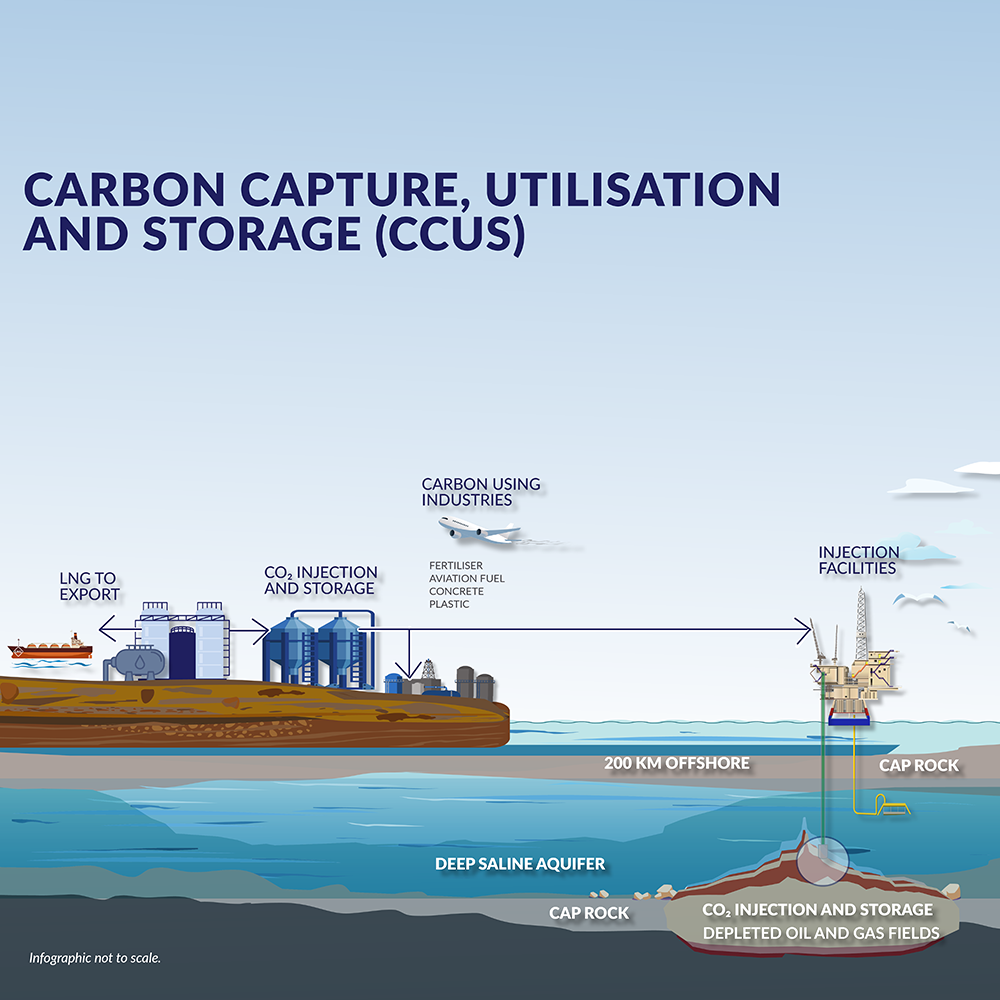
-
CCUS technologies are developing rapidly to support energy-intensive industries to reduce emissions and lead the transition towards net-zero emissions by 2050. The Northern Territory Low Emissions Hub Business Case project, established on 26 October 2021, is accelerating efforts to reduce emissions in Northern Australia and accelerate the creation of low-emission advanced manufacturing industries. CCUS is a critical enabler to realising a low-emissions hub for industries in the Middle Arm Precinct. It can support significant carbon abatement from a range of heavy industries today as the world transitions to clean energy technologies and renewable energy solutions
A CCUS hub as part of the Middle Arm Precinct could mitigate emissions from existing and future natural gas processing and will accelerate low-emission industry development, including hydrogen production. At least 90 per cent of Middle Arm Precinct emissions would be captured, compressed and transported to nearby geological storage formations for permanent storage.
The proposed Middle Arm Precinct and CCS hub co-location minimises capital-intensive construction and ongoing operating cost to benefit all precinct occupants and is further enhanced by proximity to offshore geological storage to reduce pipeline and transport costs.
In partnership with the CSIRO, industry and engineering companies, we're collaborating to develop one of the world's largest multi-user facilities of its kind. Integration of a diverse range of clean energy technologies such as CCUS is essential to realising sustainable industry growth whilst propelling our transition to a net-zero emissions future.
It will apply best practice learnings from international low emission industrial hub projects and techno-economic models to map development pathways and highlight investment opportunities.
Early feasibility of a Darwin-based CCS hub and action plan to accelerate development was completed as part of the Carbon Capture and Storage Hub Study PDF (13.1 MB)
The project will also consider all technology solutions and engage with industry and community stakeholder groups. The partnership is advancing potentially the largest CCUS project in the world to transform existing industry, enable low-emissions hydrogen, ammonia and petrochemicals sectors in the Territory.
To find out more information about CCUS at Middle Arm, go to the Middle Arm Precinct website.